|
This site is dedicated to Amerynd Flute,
( the ‘y’ is pronounced as in ‘rhyme’) a cover-all word created by Tony Morris for Native American and Native American Style Flutes. The music created by Tony Morris on this instrument is inspired by the landscapes and seascapes of the United Kingdom is. In that sense it is not Native American. His first Amerynd Flute album, “Sprites – Water and Land” amply demonstrates this. Principally a collection of 8 to 10 minute pieces with track names such as “Wild Wood”, “High Tide”, “Heather” the music giving an account of the erotic nature of the English Countryside. The calming and healing qualities of the music Tony Morris creates are important to him. This is displayed in the soaring qualities of “Clear Morning”, a track from “Guerrilla Pilgrims” and “Drowned of the Esk Rise and Fall” a sombre, gothic piece with a background of a running water and wind, a track from “Rail Bridge MWB 2/81”.
Tony Morris frequently plays his Amerynd Flutes with other folk musicians in the folk clubs of the North-East of England.
He has played Amerynd Flute on the BBC North Yorkshire Folk Programme and on Bob Fischer's 'BBC Introducing' Programme on BBC Radio Tees. Tony Morris delights in recording on location, particularly one that has a good resonant acoustic, and loves the unscheduled ambient sounds. He has recorded in various Churches in the Esk Valley in North Yorkshire accompanied by violin. The resulting album is called “Guerrilla Pilgrims”. Another recording was made under the Railway Bridge at Glaisdale, North Yorkshire that carries the Esk Valley Railway from Whitby to Middlesbrough, described by Victoria Wood as the most beautiful rail journey in England. This album, “Rail Bridge MWB 2/81” takes its name from the official bridge number, the MWB standing for “Middlesbrough Whitby Bridge”.
His latest album, 'Flute Salad' was recorded in The Hermitage in the Sneaton Forest, North Yorkshire which is on the National Coast to Coast Walk. The Hermitage was carved inside a large boulder in 1790 as a folly. It can be seen on some of the Videos on the Video link on this website. The album was released on 1 October 2012. Details of how to buy it or individual tracks are on the Listen/Buy page of this website. |
Tony Morris associates his music with storytelling, weaving narratives around the flutes, each of which has an individual voice. This is a particularly useful technique when performing for children in schools. It also gives an extra dimension to his concert performances.
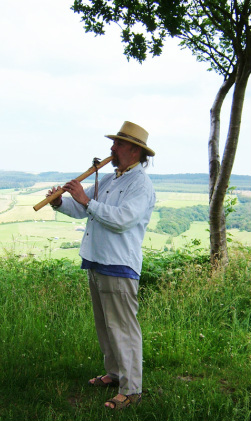
Tony Morris prefers to work without the electronic assistance so much used by many players of the Native American Flute preferring to rely on the true voice of each instrument and the natural acoustic of the venue but does concede that electronic assistance can add an extra voice to the true voice of the instrument. as in 'Larpool Woods' from the virtual album, "Eskside".
Tony has now adapted the use of a Shruti Box, an Indian instrument originally used as an accompaniment while practising ragas, to provide a drone, or, in the case of drone flutes, an extra drone.
|